Getting your first aid certificate in NSW doesn’t have to be a headache. Whether you’re doing it for work, school, or just peace of mind, the process is actually pretty straightforward once you cut through the jargon.
At Multisec Training, we’ve seen thousands of students walk through our doors in Auburn. Most of them want the same thing: a course that doesn’t waste their time, a certificate that’s actually valid, and a trainer who knows their stuff.
Here is your “no-nonsense” guide to getting certified in NSW.
Table of Contents
ToggleWhat Is a First Aid Certificate in NSW?
In simple terms, a first aid certificate is proof that you’ve been trained to handle medical emergencies until the pros (paramedics) arrive.
To be worth the paper it’s printed on, it must be nationally recognised. This means it has to be issued by a Registered Training Organisation (RTO). Whether you’re a security guard, a childcare worker, or a tradie, employers in NSW won’t accept “Mickey Mouse” certificates, they want to see the official RTO stamp.
Which First Aid Course Do You Need in NSW?
This is where most people get tripped up. There isn’t just one “first aid course.” Depending on your job, you might need a specific unit.
CPR (HLTAID009)
- Who needs it: Almost everyone. It’s often a standalone requirement for nursing students, personal trainers, and lifeguards.
- Validity: You need to refresh this every 12 months.
Provide First Aid (HLTAID011)
- The Big One: This is the standard “workplace first aid” certificate.
- Includes CPR: If you do this course, you get the HLTAID009 (CPR) unit included automatically.
- Validity: Valid for 3 years.
Other First Aid Courses
If you work in childcare or a school, you’ll likely need HLTAID012 (Provide First Aid in an Education and Care Setting). It covers everything in the standard course plus child-specific emergencies like asthma and anaphylaxis.
Step-by-Step: How to Get Your First Aid Certificate in NSW
Getting certified isn’t rocket science, but you do need to follow these four steps to stay on the right side of the law.
Step 1 – Choose a Nationally Recognised RTO
Don’t fall for “online-only” certificates that claim you’re certified in 20 minutes for $20. If they aren’t an RTO (like Multisec Training, RTO #45548), your boss will likely tell you to do it again.
Step 2 – Decide on Your Training Style
- Blended Learning: You do the “boring” theory part online at your own pace, then come in for a quick practical session. This is the most popular choice.
- Face-to-Face: You do the whole thing in the classroom with a trainer.
Step 3 – Complete the Training & Assessment
You’ll have to show you can actually do the work. This usually involves:
- A multiple-choice quiz (theory).
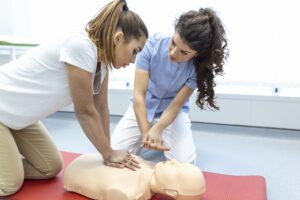
- Demonstrating CPR on a manikin (practical). You must be able to do this on the floor for at least 2 minutes to pass.
Step 4 – Receive Your Certificate
Once you pass, the RTO will issue your Statement of Attainment. Most reputable places (including us) send this to your email the same day you finish.
How Long Does It Take?
Time is money, so here’s the breakdown:
- CPR Only: About 2–3 hours in person.
- Full First Aid (HLTAID011): If you do the online theory first, the practical session usually takes 4–6 hours.
- Same-Day Service: If you’re in a rush, look for providers that offer same-day certificate issuance so you don’t have to wait around.
How Much Does a First Aid Certificate Cost?
Prices in NSW vary, but you usually get what you pay for.
- CPR (HLTAID009): Expect to pay between $50 and $80.
- Provide First Aid (HLTAID011): Generally ranges from $90 to $160.
Note: Group bookings for workplaces often come with a cheeky discount.
Is an Online First Aid Certificate Valid in NSW?
Yes and No. You can do the theory online, but SafeWork in NSW and national standards require a face-to-face practical assessment for the certificate to be valid. If a website tells you that you can become a certified first aider without ever touching a manikin, they are “pulling your leg.”
How Long Is a First Aid Certificate Valid?
Don’t “set and forget” your training.
- First Aid (HLTAID011/012): Valid for 3 years.
- CPR Component: Must be refreshed every 12 months to stay compliant with Australian Resuscitation Council (ARC) guidelines.
Who Needs a First Aid Certificate in NSW?
It’s not just for doctors and nurses. In NSW, you’ll likely need one if you are:
- Security Guards: It’s actually a prerequisite for your license.
- Construction Workers: Often required for site safety.
- Childcare & Teachers: Non-negotiable for anyone looking after kids.
- Hospitality Workers: Most venues need at least one “First Aid Officer” on shift.
Common Mistakes to Avoid
- Choosing a “Fake” Provider: Always check for an RTO number.
- Taking the Wrong Level: Check if your boss wants HLTAID011 or the childcare-specific HLTAID012.
- Letting it Expire: Mark your calendar! An expired certificate is as useful as a chocolate teapot in a workplace incident.
Get Certified with Multisec Training in Auburn
At Multisec Training, we don’t do boring things. Our trainers are industry experts who have handled real emergencies. We offer:
- SLED-Approved Training (Perfect for security guards).
- Same-Day Certificates so you can get to work immediately.
- Central Auburn Location with plenty of parking.
Book Your First Aid Course Today
FAQs
1. Can I get first aid certified in one day?
Yes. Most people do the theory online the night before and finish the practical in one day.
2. Is first aid mandatory for my job?
If you work in security, childcare, or construction, usually yes. Check your specific industry Award.
3. Does HLTAID011 include CPR?
Yes, HLTAID011 covers the CPR unit (HLTAID009) as part of the course.
4. Can employers pay for my training?
Absolutely. Many businesses pay for their staff to get certified to meet WHS (Work Health and Safety) laws.